
Speed to Lead: How Fast Should You Respond to an Enquiry?

Speed to lead is the time between someone contacting your business and a person from your business replying. The best-known research on it is a Harvard Business Review study from 2011. Firms that tried to contact a lead within an hour were nearly seven times as likely to qualify it as firms that waited even one more hour, and more than 60 times as likely as firms that waited a day or longer (Oldroyd, McElheran and Elkington, HBR).
Those numbers are real, and they are easy to misuse. This guide covers what the research measured, what it doesn't show, and a reply standard a business without a sales team can actually keep.
What the research found
The HBR article reports two pieces of work.
The first was an audit. The researchers sent a web-generated test lead to 2,241 US companies and timed the replies. 37% responded within an hour and 16% within one to 24 hours. Another 24% took longer than a day, and 23% never responded at all. Among the companies that did reply within 30 days, the average wait was 42 hours.
The second looked at 1.25 million leads received by 29 consumer-facing and 13 business-to-business companies. HBR counted a lead as qualified when the company had a meaningful conversation with a key decision maker. That analysis produced the headline comparison above: within an hour against an hour later, and against a day or more (figures as quoted from the article by SmartCompany).
What it doesn't show
- It is from 2011 and it is American. Nothing here proves the same gaps hold in your market today.
- It compares firms; it can't prove cause. Companies that reply fast may differ in other ways, such as better-run teams. Observational data shows a strong association, not proof that speed alone produced the gap.
- It measured contact attempts by the company. An automatic acknowledgement is a different thing. It tells the lead their message arrived. It is not the conversation.
- It has no five-minute rule. You will see other multipliers online for replies within minutes. I could not trace them to a primary source, so I have not used them.
The honest reading: replying inside the first hour is associated with far better outcomes, and most businesses miss that window.
A reply standard a small business can keep
This is my recommendation, not a finding from the study. The study's threshold is one hour, so the standard is built around it.
- An automatic acknowledgement within a minute. It confirms receipt and says when a person will reply.
- A person replies within an hour during working hours.
- Outside working hours, first thing the next working day. Say so in the acknowledgement so nobody is left guessing.
- A reminder if nobody has replied. Whoever owns the lead gets a nudge after a set time.
If you cannot keep the promise in the acknowledgement, change the promise, not the wording.
How to measure your own speed to lead in 15 minutes
You don't need software to find out where you stand.
- Pull your last 20 enquiries from every place they arrive: the website form, email and WhatsApp.
- In a spreadsheet, write down when each one arrived and when a person first replied.
- Count the ones with no reply at all.
- Look at the median wait and the worst three.
- Look for patterns. Is it one channel nobody checks, one time of day, one person on leave?
Most people are surprised by step 3.
What to automate, and what not to
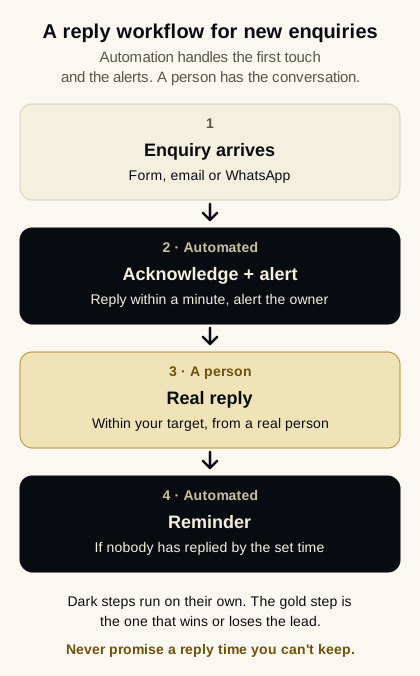
Automation handles the first touch and the alerts. A person has the conversation.
Automate the acknowledgement, an instant alert to whoever can reply (a phone notification, WhatsApp message or email), routing by enquiry type, and a reminder when nothing has happened by the deadline.
Keep a person on the first real reply, at least for enquiries that matter to you. A fast message that does not answer the question only moves the delay one step along.
Common ways speed to lead breaks
- The form sends to an inbox nobody watches, or to spam. Test the form on a schedule. Our website care plan guide covers form checks.
- The acknowledgement promises a reply time you can't keep.
- One person owns every reply, with no backup for holidays or sick days.
- Enquiries arrive on channels nobody checks, such as WhatsApp or social messages.
How Corevalo approaches it
The Business Automation service connects the tools you already use so that leads, follow-ups and reporting happen automatically. The lead workflow on the Work page shows one way that comes together. To see how enquiries get scored before anyone replies, read our guide to AI lead qualification.
Frequently asked questions
Do I need to reply within five minutes?
The research cited here compares replying within an hour with replying later. It does not set a five-minute rule.
What if I'm a one-person business?
Use an instant acknowledgement, an alert to your phone, and honest hours. Then keep the promise in the acknowledgement.
Does an automatic reply count?
It buys you time and confirms receipt, but the conversation still needs a person. The HBR figures describe contact attempts by companies, so an auto-reply is not what was measured.
Want help setting this up?
Book a call and we'll map out how enquiries reach you today and where they slip.
Sources: Oldroyd, McElheran and Elkington, The Short Life of Online Sales Leads, Harvard Business Review, 2011 (BYU record) · SmartCompany, quoting the article's audit and lead-response figures